Why Your 2 PM Energy Crash Has Nothing to Do With Lunch
You've tried the cold brew. You've tried the standing desk. You've tried eating lighter at lunch, going to bed earlier, cutting the afternoon sugar. And yet, somewhere between 1:30 and 3:00 PM, your body just... quits.
What if the culprit isn't your diet, your schedule, or even your sleep — but the way you've been sitting for the past six hours?
This is exactly what Thai massage therapists have been observing for years in the bodies of American desk workers. And the science behind it is more interesting than most people expect.
Posture Isn't Just About Your Back
Most of us think of bad posture as a structural problem — slouching leads to back pain, hunching leads to neck tension. That's true, but it's only the surface of the story.
What's happening underneath that slouch is a cascade of neurological events that directly affect your energy levels, your mood, and your ability to concentrate.
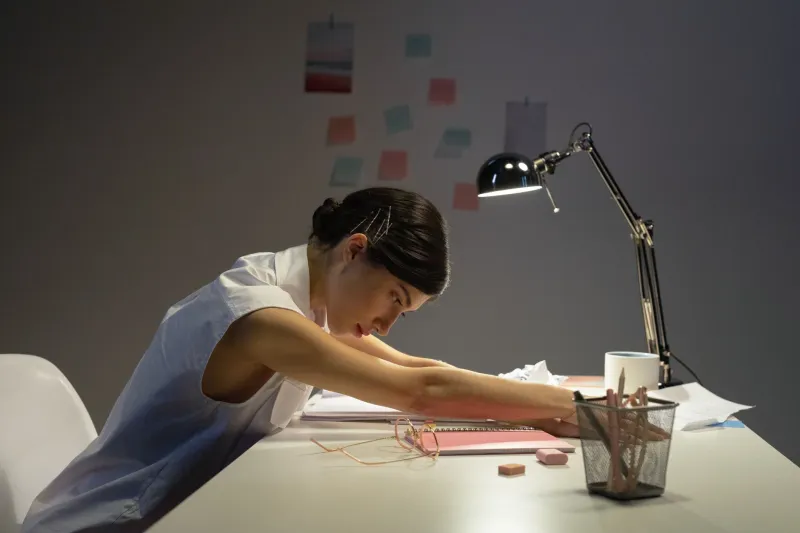
When you collapse forward at your desk — chin jutting out, shoulders rounding, lower back flattening — you're not just compressing discs and straining muscles. You're physically compressing the thoracic region of your spine, which happens to be where a significant portion of your autonomic nervous system lives. Specifically, you're interfering with the parasympathetic nervous system's ability to communicate effectively throughout your body.
The parasympathetic system is the one responsible for rest, digestion, and recovery. When it gets suppressed — even subtly, even chronically — your body reads that as a low-level stress signal. Your sympathetic system picks up the slack, keeping you in a mild but persistent state of alert. And that costs energy. A lot of it.
By early afternoon, after hours of this quiet physiological drain, your reserves are gone. The crash isn't a sugar spike coming down. It's your nervous system waving a white flag.
What Thai Massage Practitioners Are Actually Seeing
When a new client comes into a session at Lek Thai Relaxation after a long workweek, experienced practitioners don't just feel tight muscles. They feel compensation patterns — the body's way of adapting to positions it's been held in for too long.
A desk worker's body tells a very specific story. The hip flexors are shortened and locked. The thoracic spine — that middle section of the back behind your chest — is stiff and resistant to extension. The posterior chain, meaning the muscles running along the back of the body from the calves to the base of the skull, is both overworked and underactivated at the same time. And the diaphragm? Often barely moving.
That last one matters more than people realize. Shallow breathing is both a symptom and a cause of postural collapse. When you slouch, your diaphragm can't fully descend. When your diaphragm can't fully descend, you breathe shallowly. Shallow breathing keeps the nervous system in a heightened state. It's a loop that feeds itself all day long, quietly depleting you.
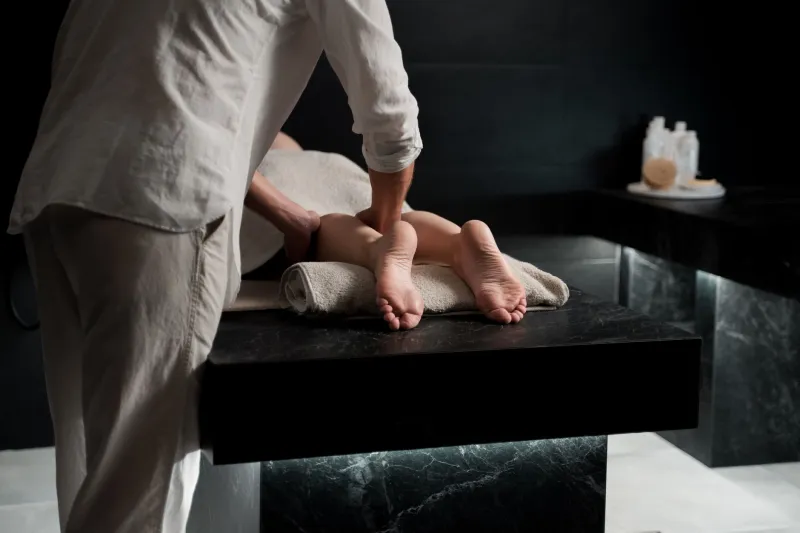
Thai massage addresses this differently than a standard deep-tissue session would. Rather than focusing on isolated muscle groups, the traditional approach works along energy lines — called Sen lines — that run longitudinally through the body. By applying rhythmic pressure and guided passive stretching along these pathways, the work begins to unwind the compensation patterns rather than just addressing the symptomatic tight spots.
The Thoracic Problem Nobody Talks About
If there's one area that desk workers need addressed most urgently, it's the thoracic spine — and it's also the area most commonly ignored in conventional massage and even in physical therapy until symptoms become severe.
A restricted thoracic spine does several things that directly affect your energy and function. It limits shoulder mobility, forcing the neck and lower back to compensate. It reduces the mechanical efficiency of breathing. And it compresses the space around the vagus nerve — the longest nerve in the body, which plays a central role in regulating the parasympathetic response.
When Thai massage work opens up the thoracic region through targeted stretching and compression techniques, clients often report an almost immediate sense of deeper breathing. Some describe it as their chest finally having room to expand. That sensation isn't just pleasant — it's the parasympathetic system coming back online.
What to Expect When You Address These Patterns
If you've been sitting at a desk for years, these postural compensation patterns don't reverse in a single session. That's important to understand going in.
The first session often focuses on assessment and initial release — a good Thai massage therapist will notice where your body resists movement, where it has lost range of motion, and where the tension is being held most persistently. You may feel relief in places you didn't even know were tight.
Over subsequent sessions, the work starts to address the deeper holding patterns. Clients often report that their afternoon energy levels begin to improve even between sessions, as the body starts to maintain better alignment on its own.
In the meantime, there are things you can do at your desk to interrupt the postural collapse before it compounds. Set a timer every 45 minutes. Stand up. Roll your shoulders back. Take three slow, deliberate breaths that push your belly out first, then expand your chest. It sounds almost embarrassingly simple — but you're manually resetting the parasympathetic signal your posture has been suppressing.
The Real Cost of Ignoring This
People tend to accept the afternoon crash as a fact of modern work life. They reach for caffeine, push through, and chalk it up to being busy or getting older. But chronically suppressed parasympathetic function isn't just about feeling tired at 2 PM. Over time, it contributes to elevated cortisol, disrupted sleep, increased anxiety, and a body that simply can't recover efficiently from daily stress.
The good news is that these patterns are addressable. The body responds. And sometimes the most powerful thing you can do for your energy, your focus, and your long-term health isn't another productivity hack — it's letting someone actually look at what your posture is doing to your nervous system, and helping you undo it.
Your desk isn't going anywhere. But the way it's affecting you doesn't have to be permanent.