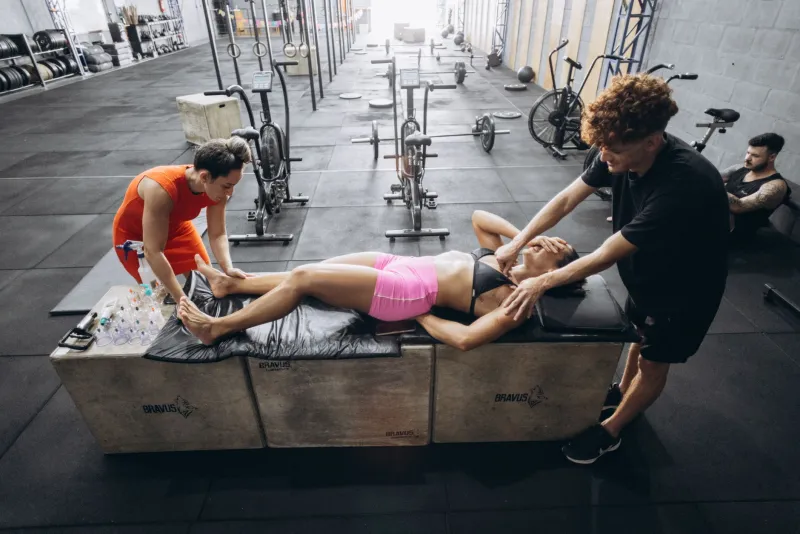
Your Body Is Paying the Price for Your Home Office Setup — Thai Massage Therapists Are Seeing the Proof

The Couch Isn't a Desk. Your Body Already Knows That.
When offices emptied out in 2020, most people figured the work-from-home arrangement was temporary. Fast forward to 2024, and a huge chunk of the American workforce is still logging hours from kitchen tables, sectional sofas, and makeshift bedroom setups. The flexibility has been great. The physical toll? Not so much.
Thai massage therapists — practitioners trained in a form of bodywork that dates back over 2,500 years — are increasingly becoming unlikely witnesses to the WFH posture crisis. What they're seeing on the treatment table tells a story that no ergonomics webinar has managed to capture quite so vividly.
What "Tech Neck" Actually Does to Your Whole Body
Most people have heard the term "tech neck" — that forward-head posture that comes from staring down at a screen for hours. But the dysfunction doesn't stop at the cervical spine. It cascades.
When your head drifts forward of your shoulders, your neck muscles — specifically the suboccipitals, scalenes, and upper trapezius — start working overtime just to keep your skull from dropping. For every inch your head moves forward, the effective load on your cervical spine roughly doubles. That means a head that naturally weighs around 10 to 12 pounds can start placing 40 to 60 pounds of force on the structures below it.
Your upper back rounds to compensate. Your chest tightens. Your lower back arches or flattens depending on whether you're perched on a hard chair or sinking into a soft couch. And your hips — already compressed from sitting — begin to lose mobility in the hip flexors and glutes, which throws your entire pelvic alignment off.
By the time someone walks into a Thai massage session, therapists aren't just treating a stiff neck. They're unraveling a whole-body compensation pattern that has been quietly building for months, sometimes years.
What Thai Massage Practitioners Are Actually Finding
Unlike Swedish massage, which primarily targets surface-level muscle relaxation, traditional Thai bodywork — sometimes called "lazy man's yoga" — works along energy lines called sen, applying rhythmic compression, assisted stretching, and joint mobilization throughout the entire body. That full-body approach makes it unusually well-suited to identifying and addressing postural chains rather than isolated tight spots.
Therapists at wellness centers like Lek Thai Relaxation report a consistent set of findings in their WFH clientele:
Locked-up thoracic spines. The mid-back is supposed to rotate and extend with relative ease. In people spending six or more hours daily at a screen, that segment often becomes rigid. The body compensates by asking the lumbar spine or neck to move more than they should — which is a fast track to pain.
Overworked rhomboids and a chronically shortened pectoralis minor. This combination pulls the shoulder blades apart and rounds the shoulders forward. It's one of the most common patterns therapists encounter, and it contributes directly to the shoulder and upper-arm discomfort that so many remote workers chalk up to "sleeping wrong."
Tight hip flexors paired with inhibited glutes. Sitting for extended periods keeps the psoas and iliacus in a shortened position. Over time, the glutes essentially "forget" how to fire properly. This imbalance shifts load onto the lower back during activities as simple as walking, climbing stairs, or standing at a kitchen counter.
Restricted ankle and calf mobility. This one surprises people. But when you're not walking between meetings, not commuting, and spending the day with your feet flat on the floor or tucked under you on the couch, the posterior chain tightens from the ground up.
Why Traditional Thai Bodywork Has an Anatomical Advantage Here
The reason Thai massage is particularly effective for this kind of postural dysfunction comes down to how it's structured. A full-session treatment doesn't just address the area that hurts — it works systematically through the body in a way that mirrors how compensation patterns actually develop.
Assisted stretches that open the chest and extend the thoracic spine directly counteract the forward-rounding that comes from screen time. Compression techniques along the posterior leg lines release tension in the hamstrings and calves that contributes to pelvic tilt. Hip-opening sequences restore range of motion in the hip flexors and external rotators that hours of sitting compress. And the attention paid to the feet and lower legs — something often skipped in other modalities — can have a surprising effect on how the whole kinetic chain above it functions.
There's also the nervous system piece. Chronic postural tension isn't just a mechanical problem. It's often accompanied by a nervous system that's stuck in a low-grade stress response, which keeps muscles in a semi-contracted state even when you're not at your desk. The slow, rhythmic pressure of Thai bodywork activates the parasympathetic nervous system, helping muscles actually release rather than just temporarily ease up.
What You Can Do Between Sessions
Therapists are quick to point out that a single session — however good — isn't going to undo months of postural dysfunction. Think of it less like a repair and more like a reset that you have to reinforce.
A few practical things that complement regular Thai massage work:
- Audit your setup. Your monitor should be at eye level so your head isn't tilting down. Your feet should be flat on the floor. If you're working from a couch, stop — or at least limit it to short stretches.
- Move every 45 to 60 minutes. Even two or three minutes of standing, walking, or gentle movement breaks the postural holding pattern before it locks in.
- Prioritize thoracic extension. A rolled-up towel or foam roller placed horizontally across your mid-back and spending just 60 to 90 seconds draping over it can do a surprising amount to counteract the rounding that builds throughout the day.
- Don't ignore your hips. A simple standing hip flexor stretch held for 30 to 60 seconds per side, done a few times a day, keeps the anterior hip from shortening into a permanent crunch.
The Bigger Picture
The WFH posture crisis isn't going away anytime soon — and for many Americans, neither is remote work. The good news is that the body is remarkably adaptable when it gets the right input. Thai massage, with its whole-body approach and emphasis on restoring range of motion rather than just chasing pain, is proving to be one of the more effective tools for giving that input.
If you've been brushing off that persistent neck ache or the low-grade tightness across your upper back as "just stress," it might be worth letting someone with a trained eye — and trained hands — take a look at what's actually going on. Chances are, they'll find the story written all over your body.